U.S. Army Integrates EchoShield Cognitive Radar with Stryker for Counter-Drone Training in Germany

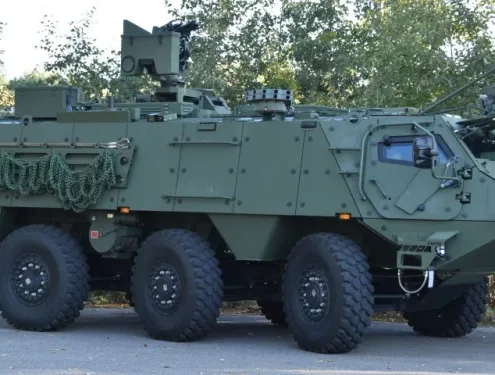
In a significant step toward enhancing battlefield awareness and drone defense capabilities, the U.S. Army has tested the EchoShield cognitive radar system mounted on a Stryker armored vehicle during a live training event in Hohenfels, Germany. The trial took place on June 20, 2025, as part of Project Flytrap, a counter-unmanned aerial systems (C-UAS) exercise focused on real-world threats in complex environments.
Developed by Echodyne, EchoShield is a software-defined, 4D pulse-Doppler radar designed to tackle the growing threat of low-altitude drones in contested airspace. Unlike traditional radars built for tracking aircraft or missiles, EchoShield excels in close-range detection with sub-0.5° angular accuracy in both azimuth and elevation. This precision is critical for effective optical tracking and effector engagement.
Operating in the Ku-band, the radar uses a dense array of transmit/receive elements to generate high-resolution spatial data. This makes it ideal for sensor fusion and integration into command-and-control systems.
Project Flytrap challenges U.S. forces to evaluate affordable, mobile C-UAS technologies in forested, rugged, and potentially hostile settings. EchoShield’s performance during the exercise showcased its ability to monitor drone frequencies, identify approach paths, and support mobile units with enhanced awareness.
The radar’s C-UAS Mission Set focuses energy on likely drone corridors while maintaining 360° surveillance, allowing for accurate classification and full-range tracking up to 4 kilometers. This ensures clean data is passed to higher-level systems for decision-making.
One of EchoShield’s key advantages is its compact and power-efficient design, which makes it well-suited for platforms like the Stryker. Its software-defined configuration allows for multiple mission modes, including:
This flexibility allows the radar to adapt quickly to changing mission profiles and operational environments.
By deploying EchoShield in the field, the U.S. Army is advancing its efforts to counter small drone threats with faster, smarter radar solutions. This real-world test marks an important step toward integrating cognitive radar technology into modern defense strategies—where agility, precision, and adaptability are key.